

IQ Capital: Opportunities, Rules, and Terms for Crypto Traders
By Yuriy Bishko September 17, 2026
12+ years in crypto trading and investing, in asset management since 2019, co-founder of BikoTrading.
Developed personal highly profitable swing and scalping strategies for the crypto market.
KEY ISSUES:
For a trader who already has their own strategy but is limited by a small deposit, proprietary trading remains one of the ways to gain access to significantly larger trading capital without having to risk the entire amount of their own funds. At the same time, prop firms differ not so much in their stated funding size as in the specific structure of their rules: drawdown, risk limits per position, requirements for consistency of results, payout conditions, and trading infrastructure.
IQ Capital positions itself as a proprietary trading company focused on cryptocurrency, CFD, and futures trading. The platform offers the best crypto trading tools for professionals, classic evaluation programs, and Instant Funding. The company states that traders can scale up to $2 million in total capital across 10 accounts, with a profit split of up to 90% and no mandatory daily loss limit under the relevant plans. Let us examine how the model works in practice, where the boundaries of acceptable risk lie, and how well the platform's rules align with trading strategies suited to different trading styles.
What is IQ Capital?
IQ Capital operates under a proprietary trading firm model: a trader gains access to the company’s capital after meeting specified requirements or can opt for Instant Funding without completing the standard evaluation process.
On its website, the company divides the trader’s journey into several stages: Challenge, IQ Funded, and the subsequent scaling level. Under the standard model, a trader first completes an evaluation and then receives a funded account. Experienced traders have an alternative route – Instant Funding. Trading is conducted within simulated evaluation environments or proprietary funded accounts, in accordance with established rules, risk limits, and contractual terms.

For readers considering IQ Capital for proprietary trading, a special offer from BikoTrading is available – an 80% discount on Instant Funding and Challenge. Under the offer, traders receive 90% of the profits, with payouts available every 3-10 days through a fast and simplified process. This is an exclusive recommendation from BikoTrading for traders looking for favorable funding terms and the opportunity to scale their own trading strategy. Follow the link to get the best prop trading deal.
We have also prepared a detailed video review of the IQ Capital platform, covering the key terms, account types, rules, and the main aspects of the trader experience.
What opportunities does the platform offer?
IQ Capital is not focused exclusively on the cryptocurrency market. The platform offers three main categories of instruments:
- cryptocurrencies;
- CFDs;
- futures.
At the same time, the cryptocurrency segment is presented as a separate offering with its own account plans, trading platforms, and risk parameters.
Which cryptocurrencies are available?
IQ Capital states that it offers a wide selection of crypto assets, including BTC/USDT, ETH/USDT, SOL/USDT, XRP/USDT, and others. In addition to major assets, the platform states that it offers more than 200 altcoins and more than 200 meme coins. Examples listed include ARB, OP, INJ, SEI, TIA, RNDR, PENDLE, AAVE, CRV, and MANTA, while meme coins include PEPE, WIF, BONK, FLOKI, SHIB, FARTCOIN, BRETT, POPCAT, GOAT, and MOODENG.
Crypto Funding
The cryptocurrency segment at IQ Capital offers several account levels:
- $50,000;
- $100,000;
- $200,000.
For the evaluation options, the website lists corresponding profit targets of $4,000, $8,000, and $16,000. The maximum drawdown is $3,000, $6,000, and $10,000, respectively. These plans feature an EOD trailing drawdown, while the maximum position loss is set at 1%.
It is important here not to confuse the account size with the actual permissible loss. For example, a $100,000 account does not mean that a trader can afford to lose tens of thousands of dollars. Under the published evaluation terms for this account, the profit target is $8,000, while the maximum drawdown is $6,000. In practice, the trader gains access to greater trading buying power but operates within a significantly narrower risk envelope.
How the Challenge works
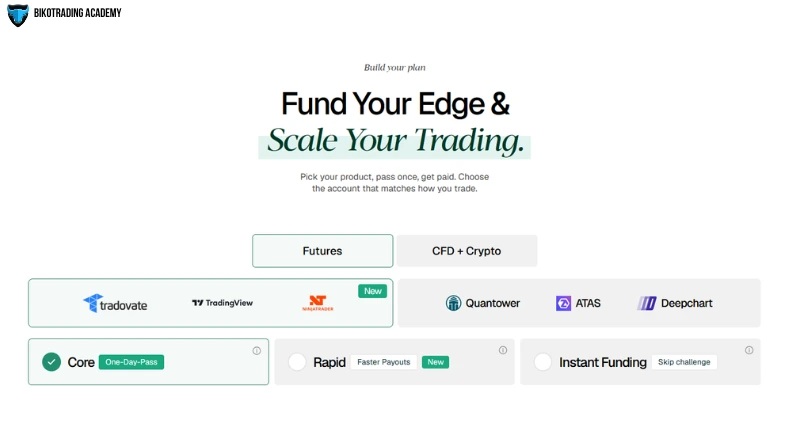
The standard IQ Capital Challenge is structured as a one-step evaluation model. Under the company’s rules, the primary objective of the evaluation is to demonstrate the ability to generate profits while staying within the established risk limits. The basic profit target is 8%. The maximum trailing drawdown is 6% for $10K–$100K evaluation accounts and 5% for the $200K evaluation.
IQ Capital does not impose a minimum number of trading days to complete the Challenge. If a trader reaches the required profit target without violating any other rules, the evaluation can theoretically be completed in just one day. For an active IQ trader, this is a significant difference from prop firms that require a minimum number of trading days regardless of how quickly the target is reached.
Instant Funding as an alternative to the challenge
The main difference is that the trader does not have to complete a profit-target evaluation. Instead, they receive a funded account immediately and can start trading. The company explicitly positions this product for traders who are already confident in their trading system and do not want to spend time on an evaluation.
However, the absence of a Challenge does not mean the absence of risk management. Instant IQ Capital Funding remains subject to limits on maximum drawdown, position loss, and consistency. According to the published rules, Instant Funding has a maximum trailing drawdown of 5%.
The economics of this product also differ from those of the evaluation. IQ Capital states on its website that Instant Funding costs approximately 3-4 times more than the Evaluation because the trader skips the verification stage.
Special features of the IQ Capital platform
EOD Trailing Drawdown
One of the most important features of the IQ Capital model is the use of End-of-Day Trailing Drawdown. IQ Capital calculates the trailing line based on the account's status at the end of the trading day.
According to the published rules, at each New York close, a trailing line is determined and set 6% or 5% below the previous highest equity value, depending on the account type. This line can only move upward and does not decrease after a drawdown.
Since the cryptocurrency market operates 24/7, the concept of “end of day” here does not correspond to the physical end of a trading day on an exchange. IQ Capital's rules use the New York close specifically as the reference point. It is therefore important to understand not only your own trading system, but also exactly when the system records a new trailing threshold.
In practical terms:
- the account reaches a new high;
- a new trailing level is established at the corresponding EOD;
- this level becomes the lower limit of the permissible equity;
- subsequent drawdown is assessed against the new level;
- the trailing line does not move back down, even if the account subsequently gives back part of its profits.
For a swing trader, this model can be significantly more comfortable than a strict intraday trailing drawdown. For a scalper or a system involving a large number of short-term trades, another rule becomes critical – the maximum loss limit on an individual position.
Position Loss
IQ Capital separately monitors the maximum loss on an individual position. In its general rules, the company specifies a limit of less than 1% or 0.5%, depending on the phase/account type. The loss calculation includes trading fees, commissions, spreads, and slippage.
If a trader opens a position with a nominal risk of, for example, 0.9%, they cannot assume that this figure will be the final result. Associated trading costs are included in the calculation. Therefore, the limit set by IQ Capital should not be viewed as a recommended risk per trade, but rather as an upper threshold that must not be exceeded. The cryptocurrency market can cover a significant portion of the distance between entry and stop-loss in a very short period, while slippage during a sharp price movement can change the actual outcome of the position.
Consistency Rule
IQ Capital imposes a restriction under which the most profitable day cannot account for more than 30% of the total profit. This rule applies to Funded and Instant Funding accounts, but not to the Challenge itself. For example, if a trader has generated $10,000 in total profit, their best trading day must not exceed $3,000.
This creates an interesting situation. During the Challenge stage, a trader can reach the profit target without a consistency restriction. However, after moving to a funded account, the model becomes more focused on the repeatability of results. In this way, IQ Capital effectively separates two objectives:
- Evaluation – demonstrate that the trader is capable of achieving the required result.
- Funded stage – demonstrate that this result can be generated systematically rather than through a single abnormally profitable day.
This means that a strategy with a highly uneven distribution of returns may be less convenient at the funded stage, even if it is capable of producing a high average return.
Scalping and the 15-second rule
IQ Capital also imposes restrictions on ultra-short-term trading. The general rules specify a 15-second holding threshold designed to prevent HFT/tick-scalping abuse. This means that traders whose strategy relies on opening and closing positions extremely quickly need to take this restriction into account before choosing a specific account plan.
At least 50% of all trades must be held for more than 15 seconds, and at least 50% of total profits must come from positions that were also held for more than 15 seconds. If these conditions are not met, the account is not eligible for a payout. Even if some trades are closed very quickly, the overall structure of the trading activity must comply with these requirements.
Therefore, IQ Capital is less suitable for strategies based primarily on:
- tick scalping;
- ultra-short-term execution;
- latency arbitrage;
- a large number of trades lasting only a few seconds;
- systems where the majority of profits are generated from micro price movements.
By contrast, conventional scalping with positions held for longer periods, intraday trading, and swing trading are better aligned with the stated model.
Soft Breach and Hard Breach
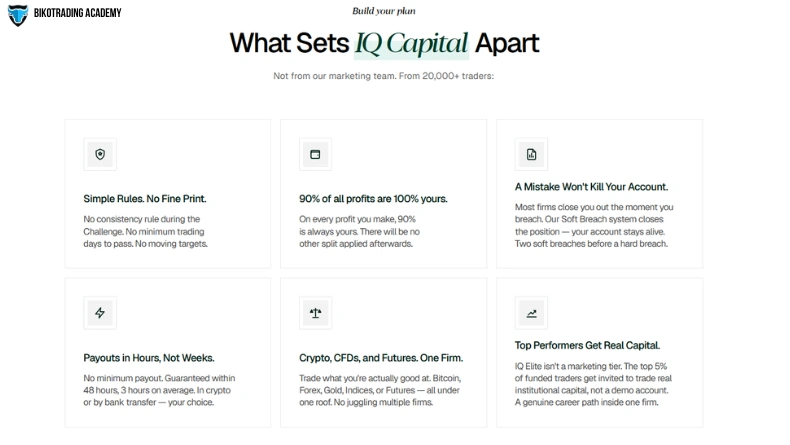
One of the most interesting features of IQ Capital is the Soft Breach mechanism. In the classic prop trading model, violating a risk limit often results in the immediate closure of the account. IQ Capital uses a different approach: the problematic position is closed, but the account itself may remain active. On its marketing pages, IQ Capital also states that traders may receive up to two forgiven breaches.
This creates an additional layer of protection against operational errors. For example, if a position exceeds the established risk threshold as one of the crypto risk management tools, the mechanism can act as a protective barrier: the position is closed, but the trader does not lose the entire funded account.
In contrast to a Soft Breach, a Hard Breach is a violation that results in account disqualification.
No daily loss limit
IQ Capital emphasizes the ability to trade without a traditional daily loss limit. In the conventional prop trading model, a trader may face a situation where, even though the overall drawdown is still well below the critical level, the account is suspended because losses exceed a certain percentage within a single day.
At IQ Capital, the primary risk control is built around the trailing drawdown. This provides greater flexibility for strategies that allow for uneven intraday performance. For example, a trader may experience a losing morning session, after which their strategy generates a signal to recover the position and finish the day in profit.
However, if a trader systematically loses a significant portion of the available drawdown in a single day, they simply move closer to the overall trailing threshold more quickly. The restriction becomes less stringent at the calendar-day level, but the overall risk budget does not disappear.
Who is IQ Capital best suited for?
Is IQ Capital suitable for a scalper?
Before purchasing an account, a scalper should run a simple backtest: take their historical trades and calculate the share of trades lasting more than and less than 15 seconds. If either metric regularly falls below 50%, the strategy may potentially be incompatible with IQ Capital's payout requirements.
Is IQ Capital suitable for an intraday trader?
For intraday trading, the structure looks significantly more interesting. The absence of a traditional daily loss limit provides more room to operate throughout the day, while the EOD trailing drawdown does not respond to every intraday equity spike in the same way as an intraday trailing model. At the same time, the trader needs to control the maximum position loss, cumulative drawdown, consistency, trading costs, and payout requirements.
For intraday systems with controlled risk per position, this can be a comfortable model, particularly if the trader does not use excessive leverage and does not rely on execution lasting only a few seconds.
Is IQ Capital suitable for a swing trader?
An EOD trailing drawdown can potentially be more convenient for positional trading than a model in which the equity floor is constantly adjusted throughout the trading day. However, a swing trader should pay particular attention to overnight rules, weekend holding, volatility gaps, position sizing, and the maximum position loss.
This is critical in the cryptocurrency market because Bitcoin and altcoins can make significant moves over several hours while the trader does not adjust the position. In such a situation, even a properly designed swing strategy can experience a substantial unrealized drawdown.
Is IQ Capital suitable for algorithmic traders?
Algorithmic trading is also possible, but several parameters need to be checked.
- If an algorithm operates with positions held for less than 15 seconds, this creates a direct conflict with the microscalping requirements.
- The automated crypto trading strategies must also avoid situations where a single trade, including the spread, commission, and slippage, exceeds the permitted risk threshold.
- In addition, the system's behavior during periods of extreme volatility needs to be taken into account. An algorithm may be statistically profitable over a large sample, but a single abnormal execution on this algorithmic trading platform for crypto traders can result in a violation of a risk rule.
Key advantages of IQ Capital
When evaluating the platform specifically from the perspective of a crypto trader, its strengths can be summarized in several key points:
- EOD trailing drawdown. For many traders, this is a more comfortable model than a strict intraday trailing drawdown.
- No traditional daily loss limit, which provides greater flexibility for intraday trading.
- Wide selection of crypto assets – more than 200 altcoins and more than 200 meme coins.
- MetaTrader 5 and Volumetrica – traders can choose between a universal trading platform and an environment focused on order flow.
- Instant Funding for experienced traders.
- Soft Breach – certain violations do not necessarily result in the immediate loss of a funded account.
- Scaling – successful traders have access to further allocation levels and IQ Elite.

Conclusion
IQ Capital offers a proprietary trading model aimed at traders who already have an established trading strategy and want to scale it using external capital. Key features of the crypto asset management software include a wide selection of crypto assets, EOD trailing drawdown, the absence of a traditional daily loss limit, several funding formats, and support for different trading styles.
For crypto intraday and swing traders, IQ Capital may be an interesting option due to its relatively flexible risk management structure and broad range of available assets. At the same time, for ultra-short-term strategies and microscalping, the established restrictions may have a significant impact on the ability to receive payouts consistently. Therefore, it is important to consider that the better a trader's strategy aligns with the platform's rules, the more practical value the proposed funding model may offer.
